Thursday, May 07, 2009
Ha Tay Visit


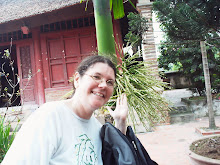
Oftentimes, I'm really proud of my students. Last week I went to Ha Tay near Hanoi with my student Huy. Huy is handicapped, but he never lets that stop him from achieving his goals. He organized a trip to Ha Tay to cheer up his friend Linh.
Ha Tay is a beautiful rural area near Hanoi. I was stunned by the lush green fields and as always, the wonderful the hospitality of the people.
Labels: ecology, education, Vietnamese culture


Monday, November 10, 2008
The Great Flood

Photo on Flickr, from "Hanoi Mark"
Last weekend a great flood inundated Hanoi. We received almost 2 feet of rain within 2 days! The streets were flooded, and yet for many of us life went on. My school was located on high ground, as is my neighborhood. Ryan, a young teacher from Australia, and I ended up teaching all the classes Saturday afternoon! We each had more than 50 children! On Sunday, more teachers made it to the school, but I still had to teach eight straight hours, followed by more on Monday night. I was exhausted! When I go through things like that, I'm amazed at my coping skills.
Ironically, my adventures were minor compared to some of my fellow teachers. Kenny was trapped in a school for several hours because the streets were impassable and Phil, after losing water in his apartment, got stuck on a flooded bus. Shelly tried to get to school, but her cab got stuck in waist high water and began "buckling."
Fellow teacher Colm Pierce is an extraordinary photographer. I'm including links below to his website as he took much better photos than I did:
http://colmpiercephoto.com/content/view/25/44/
http://www.colmpiercephoto.com/
(Click "Hanoi underwater" for a fantastic slideshow")
Labels: ecology, education, Ha Noi
Saturday, February 17, 2007
Rescue Me!

On Saturday a friend of mine, Tracy, and I went on a nature tour of the island. One of the highlights of the trip was a visit to a Gibbon preserve and Thai national park. The gibbon preserve was very interesting as we arrived early in the morning and heard the apes "singing," which is hard to describe except as a "long, haunting call." Most of the apes had been rescued from abusive owners in various parts of Thailand by either tourists or Thai people. The animals had been kept in small bird cages, or beaten for singing, which is their natural instinct to try to find mates. Now the animals are kept in a large compound where they can sing, swing and play. Volunteers from overseas help take care of the animals and have established three families, with hopes of eventually releasing the offspring into the wild.
Right from the gibbon reserve, we climbed up to a beautiful waterfall. This was quite a challenge for me, however, because the ride on the motobike the night before had destroyed my shoes. All I had left to wear was a pair of open toed shoes that were not designed for walking. Fortunately, we had a great guide, a young Thai man named Nicky. He helped me up some of the steeper portions of the hillside. There are steps cut into the hillside, but they are very rough and uneven. He was always there to take my hand and make sure I didn't "take a header" down the trail. Nicky led us under a thick canopy of rainforest to a small waterfall. The water was clean and cool and I splashed my face with it. We beat the other tourists there so it was absolutely quiet except for the music of the waterfall. The waterfall was not so intense as it will become in July, when the full force of the water makes for a grand sight.
After going to the park, we stopped at an elephant camp and watched a monkey show and rode a Thai elephant. Thai elephants are smaller than their African and Asian cousins, but still are very impressive animals. This was my first time riding an elephant and I was a little scared. But actually the elephants have a slow, steady pace and it is quite calming to "be onboard."
To finish the outing, we went on a canoe ride through a mangrove swamp. There was an incredible amount of vegetation and these trees rising out of the water. I saw a wading bird that looked like a small stork. The lunch at the restaurant nearby was spectacular. Vegetables and chicken was served in a delicious Mussaman curry sauce and fresh fruits and vegetables were carved into the shape of hearts, flowers and butterflies.
Our guide for the outing was Nicky. Not only did he save me from possibly breaking a bone, but he was extremely knowledgable about Phuket island. He told us that about 200,000 people lived on the island. Fifty percent are foreigners; many are Burmese refugees working in the tourist industry as laborers, and a sizeable chunk are "Europeans;" non Thai people from Australia, North America and Europe who have decided to retire or live and work in Phuket. Before the tourist industry exploded, the majority of people worked on rubber plantation. Rubber trees are highly resilent and can be harvested for about 14 years. When the trees are being harvested for sap, people get up at around 3 a.m. and carefully cut the trees. The work needs to be done during the coolest part of the day. Rubber planters practice crop rotation so that when some trees are at the end of their life span, there are others ready to take their place. The old trees are chopped down and sold for firewood.
So it was a very adventurous and educational day in Phuket.
Labels: ecology, gibbon, Thailand